Leadership and Purpose
Treat AI as strategic business redesign, define ownership, and preserve long-term agency as dependency grows.
Board-Level AI Stewardship
Stewardship, Strategy, and Accountability in the Age of AI
A practical handbook for chairs, non-executives, audit and remuneration committees, general counsel, company secretaries, chief risk officers, and advisers who need to govern AI as a material feature of strategy, control, people, and trust.
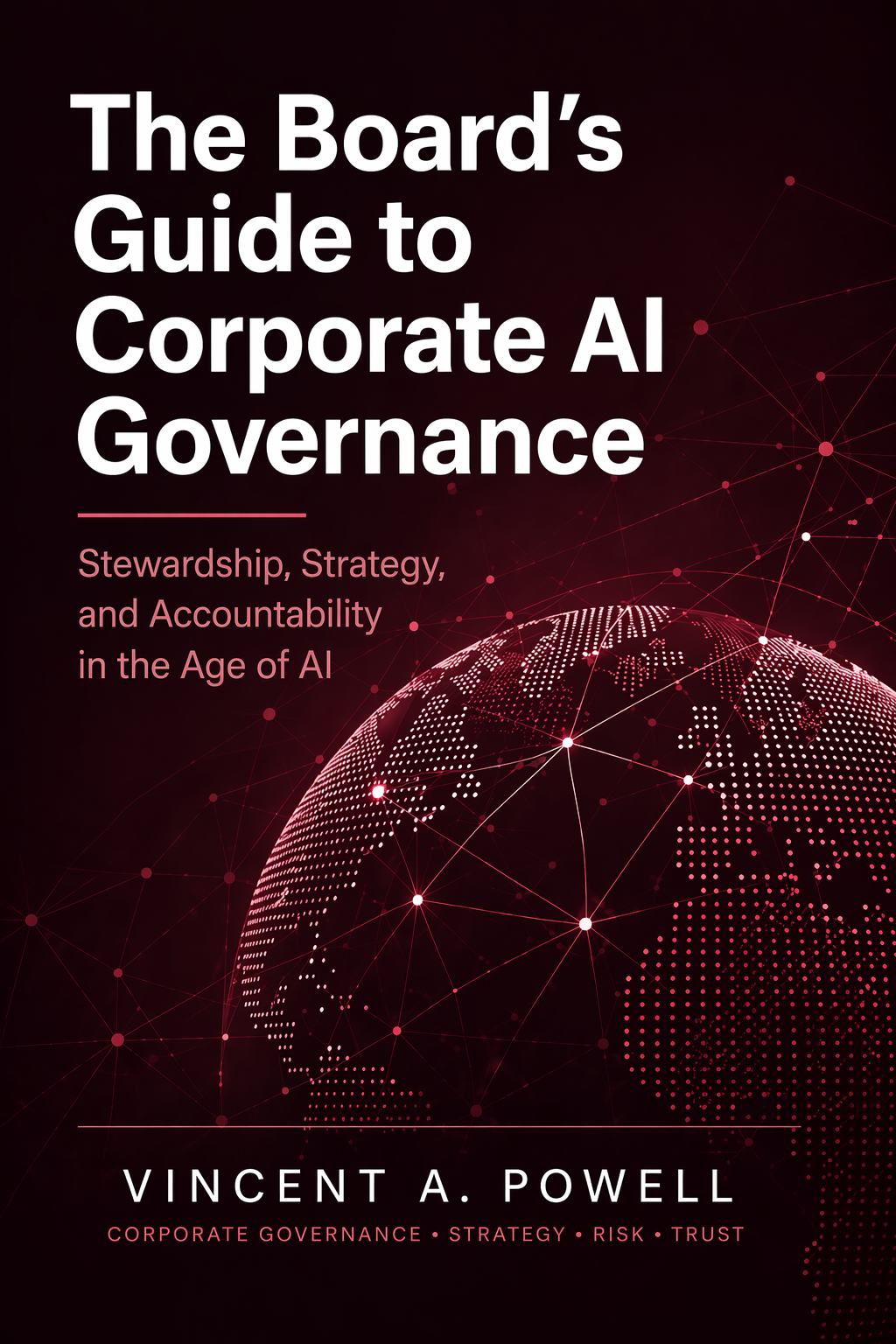
Why This Book
Artificial intelligence is no longer sitting at the edge of the enterprise as a specialist experiment. It is shaping prices, approvals, hiring, customer interactions, surveillance, escalation, and reporting. Once AI starts influencing consequential outcomes, it stops being only a technology matter and becomes a board matter.
This book argues that boards do not need to become technical committees, but they do need a governance discipline that is specific enough to handle decision rights, override, explainability, dependency, assurance, workforce transition, and disclosure.
The Corporate AI Governance Code
Treat AI as strategic business redesign, define ownership, and preserve long-term agency as dependency grows.
Clarify board, committee, and executive accountability so AI governance is coherent across the organisation.
Document how AI advises, automates, and acts, with named human accountability for material outcomes.
Integrate AI into enterprise risk, lifecycle control, intervention capability, assurance, security, and data governance.
Govern workforce transition, incentives, trust, and the changing contract between employer and employee.
Ensure disclosure, recordkeeping, challenge, and evidence are strong enough to support real accountability.
Inside the Book
Why AI is now a board matter, why existing governance is necessary but insufficient, and why boards must integrate the full picture.
A proposed comply-or-explain code for boards covering scope, definitions, principles, and detailed provisions.
Board ownership of AI strategy, technological dependency, resilience, and strategic optionality.
Governance structure, executive accountability, board competence, and independent scrutiny.
Decision classification, override, escalation, high-stakes review, and agentic operations.
AI risk taxonomy, lifecycle controls, third-party due diligence, security, data governance, and transaction oversight.
Workforce impact, reskilling, transition, culture, trust, and incentives for responsible AI adoption.
Disclosure, stakeholder communication, evidence, challenge, and the conditions for credible accountability.
A structured maturity model that helps boards distinguish between credible progress and performative oversight.
A practical operating rhythm for committees, management reporting, evidence gathering, and annual review.
Who It Is For
Built for Use
Use the code provisions, maturity questions, and governance expectations to structure agendas and challenge management reporting.
Translate governance intent into tangible artefacts, evidence trails, and records that show AI oversight is operating.
Pressure-test whether AI governance is emerging, disciplined, and resilient rather than ceremonial or fragmented.
Move from principles to operating rhythm with a roadmap that boards and executives can actually run through the year.
Availability
The book is now published and available through Amazon. ISBN-10: 191951855X. ISBN-13: 9781919518558.

Oblongix Advisory Publishing
Executive transformation
Leadership, value, risk and organisational reality for CEOs turning AI into business redesign.
Explore the CEO's GuideThe agentic enterprise
What the firm becomes when AI moves from a tool at the edge to an operational actor.
Explore Human & AI at WorkPublisher catalogue
View the complete catalogue, confirmed editions and publication information.
Visit the publisherBring It Into the Boardroom
Contact Vincent A. Powell for book enquiries, speaking, governance workshops, advisory support, or board and committee sessions focused on AI accountability.